

Talk to a real person when you need to
There are some things that AI chatbots just cannot do
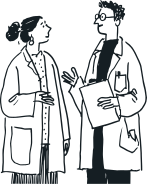
AI chatbots are tools which can help you manage your health, but they cannot replace healthcare professionals. Humans and AI chatbots work in different ways and are good at different things.
This is the one thing you should definitely not use a chatbot for. AI chatbots can miss things that are very risky. When researchers at the Icahn School of Medicine at Mount Sinai tested ChatGPT Health against realistic emergency scenarios, it missed half of the cases that doctors agreed needed emergency care, including people at risk of suicide.1

Recommendation:
If you think you or someone close to you is having a health emergency or is in immediate danger, get help from a trained health professional straight away. If you are in the UK, call 999 or go to A&E as soon as possible.
If you are not sure how urgent it is, call NHS 111, which is free and open 24 hours a day. If you are feeling low or struggling to cope, you can call Samaritans free on 116 123 or text SHOUT to 85258 at any time of day or night.
In many countries outside of the UK, you can often reach the emergency services by dialling 911 or 112. You can use this website to find help:
https://findahelpline.com
AI chatbots are computer programs which have been trained on vast amounts of information. Many chatbots have access to the internet, including published scientific research. Some studies have shown that AI chatbots can be better than humans at working out the answers to written medical questions and exam-style problems.2
However, there is much more to being a healthcare professional than simply knowing facts.
Healthcare professionals can review your past medical history, ask you questions you may not have thought were relevant, and examine you to look for evidence of certain diseases. They will look at your existing test results and may recommend that you have further tests to help you get a diagnosis.
Once you have a diagnosis, they can recommend treatments which should help. Importantly, they also take into account your values and wishes and help you make health decisions that are right for you.
Healthcare professionals are also held accountable by regulations and laws in ways that AI chatbots are not.
It might be better to speak to a healthcare professional if:
- You think a chatbot is giving you incorrect information,
- The conversation is going around in circles,
- You find its responses confusing,
- Your condition is getting worse,
- You are thinking about starting or stopping a medication,
- Or you are not sure what to do.
If you can't easily get an appointment with a healthcare professional, you could also try talking to someone else you trust. You could also look for trustworthy sources of health information online. Read more about how to find trustworthy health information.
It's your choice if you use an AI chatbot to ask questions about your health. You don't need to tell anyone if you don’t want to, even your doctor. Getting information about your health is nothing to be embarrassed about.
But if a chatbot response has worried you, or you want more information from someone qualified to give advice, it might be helpful to talk about it.
Many doctors would prefer to know exactly what their patients are worried about. This means they can give advice on the right things. Your doctor or another healthcare professional will be able to help you understand information you've been given by a chatbot. There might be some things which are useful, but there might also be areas where the chatbot has got things wrong.
- https://www.nbcnews.com/health/health-news/chatgpt-health-under-triaged-half-medical-emergencies-rcna261409
https://www.nature.com/articles/s41591-026-04297-7 - https://www.theguardian.com/technology/2026/apr/30/ai-outperforms-doctors-in-harvard-trial-of-emergency-triage-diagnoses
https://www.science.org/doi/10.1126/science.adz4433